

The escalation manager had the fix ready by Tuesday. The workaround was tested, the customer’s engineers had seen it run, and the plan was on one page.
On Wednesday morning the VP joined the call and walked the customer through it.
That afternoon the customer’s director sent a thank-you email. It went to the VP.
Nobody planned it that way. The VP did not reach for the credit. The escalation manager noticed anyway, and so did everyone copied on the email. Next time, the escalation manager will wait for Wednesday.
Rescue solves the moment, but it can train dependency.
What rescue gives you
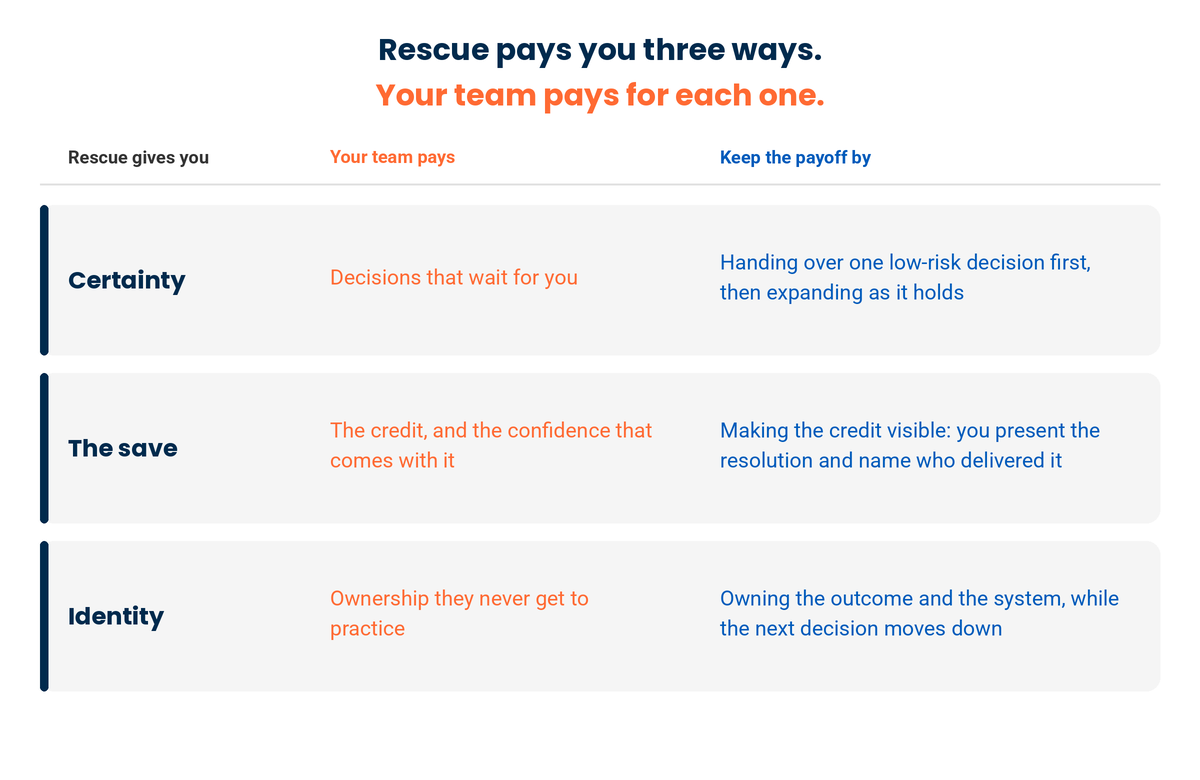
Rescue pays you in three currencies, and all three are legitimate.
Certainty. You are trusting a customer relationship to someone you may never have worked with directly. Your team pays with decisions that wait for you. In a 1999 study published in the Journal of Organizational Behavior, Gary Yukl and Ping Ping Fu surveyed managers and their direct reports and interviewed managers. Greater delegation was associated with shared task objectives and stronger working relationships. Managers also reported reluctance to give up control over important decisions.
The save. Fixing the moment feels good at every level, including yours. Your team pays with the credit, and the confidence that comes with it.
Identity. Stepping back can feel like giving up ownership as the senior person in the room. Your team pays with ownership they never get to practice.
A request to simply stop rescuing takes all three away and replaces nothing, which is why it does not hold. Demartini uses a method for changing a habit that fits here: name what the habit gives you before you try to replace it.
Count the cost first
Before you change anything, write three lines on one page:
How many hours a week you spend on customer crises: preparation, updates, meetings, visits, every related call.
How many of those hours you wish your team could handle without you.
The second number multiplied by 52.
Eight hours a week is about ten working weeks a year. What would those ten weeks buy? The strategic work your own leadership expects from you, managers who finally get to lead, or your evenings.
That number is the price of every save.
Keep the payoff, drop the rescue
For certainty, start with one low-risk decision and let it go first. Expand from there as it holds. Confidence is built before the escalation. Last month’s strategy conversation can help lay that groundwork: shared objectives, said out loud.
For the save, make the credit visible on purpose. Rescue’s reward is instant and public. Development’s reward is slow and quiet. Present the resolution yourself and name the person who delivered it.
For identity, keep ownership where it belongs: the outcome and the system. The next decision moves down. Owning a domain never required being present for every decision inside it.
Be the leader whose team gets the thank-you email.
Get the free Pro-Tip Sheet: Three Currencies of Rescue. What rescue gives you, what it costs your team, and how to replace each payoff.