

Late at night in a Mexican restaurant in Chicago, three young workers who looked like a construction crew were listening to the oldest of the group, who was clearly running the table.
Two people in business clothes sat down nearby. The crew’s leader went quiet.
Then someone who looked even more powerful walked in. The two business people went quiet.
Nobody asked anyone to stop talking. Nobody claimed authority. It moved on perception alone. Dr. John Demartini tells that story in The Seven Secret Treasures.
Now picture your next customer escalation. Your escalation manager is running the call. The customer is listening. Then you join.
You do not have to say a word. If nobody agreed in advance which decisions belong to your manager, your manager will assume you are taking over and wait for your signal. The customer watches the decisions move up the chain in real time.
Authority you do not assign before an escalation gets assigned by rank during it.
Research published in the Academy of Management Journal in 2011 by James Detert, then at Cornell, and Amy Edmondson of Harvard found that employees carry unwritten rules about when speaking up to those above them is risky or inappropriate. These taken-for-granted beliefs predicted silence at work beyond the other individual and workplace factors the researchers tested. Your manager may not need anyone to tell them to defer. The rule may have been in place long before the call.
Telling your team they are empowered does not settle it. That is a general statement, made in private, about no particular decision. Joining the call and staying quiet does not settle it either. Your manager is still reading you for the signal.
The skill: give the mandate before the pressure arrives
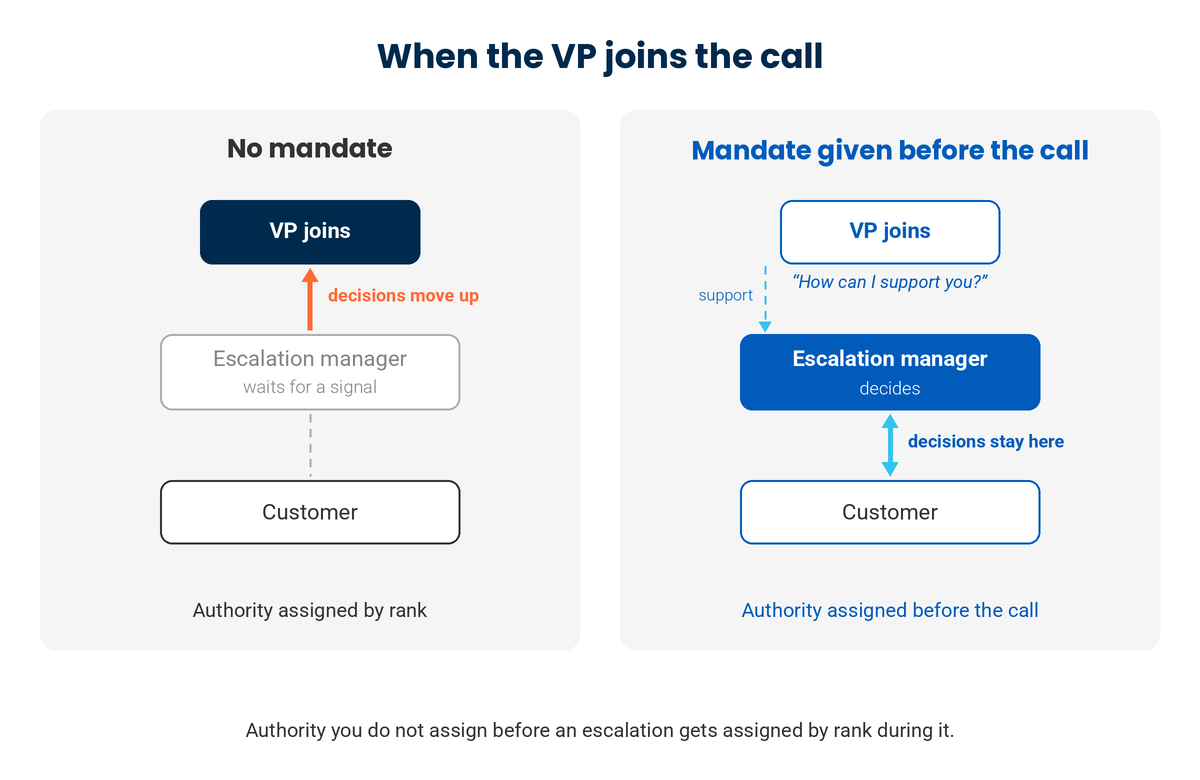
You are the one person on that call who can override the unwritten rule. It takes two minutes and one sentence, and it has to happen before the call.
Before the next customer meeting, ask the person closest to the problem one question: what is your strategy? Listen to the whole answer before you add anything.
Then say the sentence: “On this, you speak for us.”
Say it where the other senior people can hear it. A mandate given in private still leaves the room guessing. A mandate given in front of the room settles who decides before anyone has to wonder.
Then hold it on the call. Your first question confirms or cancels the agreement. A question to the engineer tells everyone you have taken over. “How can I support you?” to your manager tells everyone the agreement still holds.
One conversation, one sentence. That is the whole assignment.
Be the leader whose team keeps deciding when you join the call.
Get the free Pro-Tip Sheet: Assign Authority Before Rank Assigns It. The mandate conversation on one page, ready for your next escalation.