

This is the first of five. Each one hands you a single move you can use in your next escalation.
Somewhere in your organization this week, a decision is sitting in a queue waiting for you. It has a perfectly good owner two levels down.
They are not stalling. They are doing the arithmetic on what happened the last four times someone at their level made that call without you.
In my own operating roles I pulled 15 to 25 hours a week of escalation work off a director and a VP. Not by working harder on escalations. By moving authority onto named owners and writing the system down.
The strangest part came at the end. For two years my team had carried the worst customer escalations in the business. Then the bridges got shorter. The 9pm calls thinned out. And someone senior asked, out loud, whether a dedicated escalation function was still worth funding.
I smiled. My proudest moment was not when leadership called me into the room. It was when the room no longer needed me.
We measure ourselves backward.
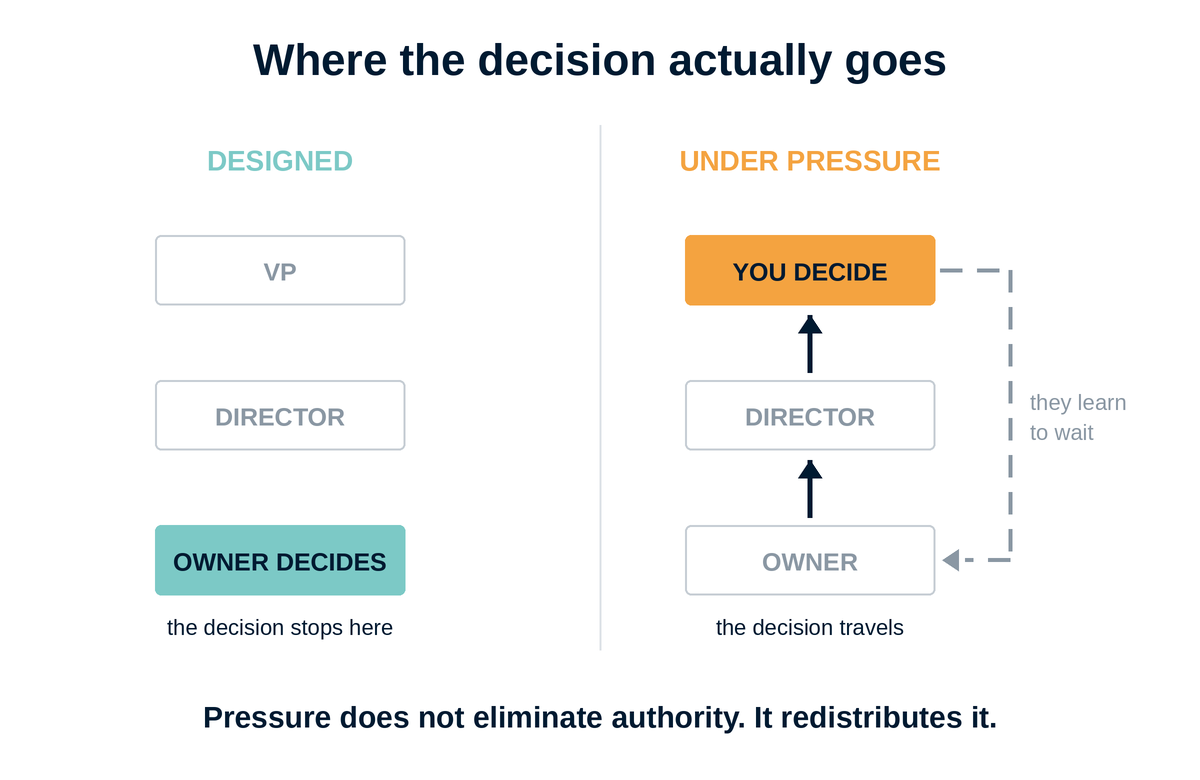
The leader who gets pulled into every critical escalation reads a full calendar as evidence of trust. It is evidence of routing.
Google's Site Reliability Engineering team publishes the conditions that trigger a declared incident: a second team must be involved, the outage is visible to customers, or the issue remains unresolved after an hour.
Impact, scope, and time. No name appears anywhere in that list.
The trigger was designed to be structural, and in most organizations it quietly became personal.
You will want to argue that your judgment is the reason those calls go well. That is probably true. It is also the problem you are being paid to solve.
Next Wednesday: why your rule for stepping in is not a rule.
You do not have to stop caring about the hard calls. You have to stop being the only place they can land.
Take the free Authority Leak Scorecard. Ten minutes, seven questions, and it shows you where authority is leaking and how much of your escalation load depends on one person.
Yuval Gonen is the founder of Dynamic Escalation Solutions. He spent 23 years at Cisco, ten of them running escalations at the highest level. He now works with B2B technology and managed service leaders whose serious customer issues keep landing on the same desk. He does not fix the code. He fixes who decides.
Source: Google SRE, "Managing Incidents." sre.google/sre-book/managing-incidents